
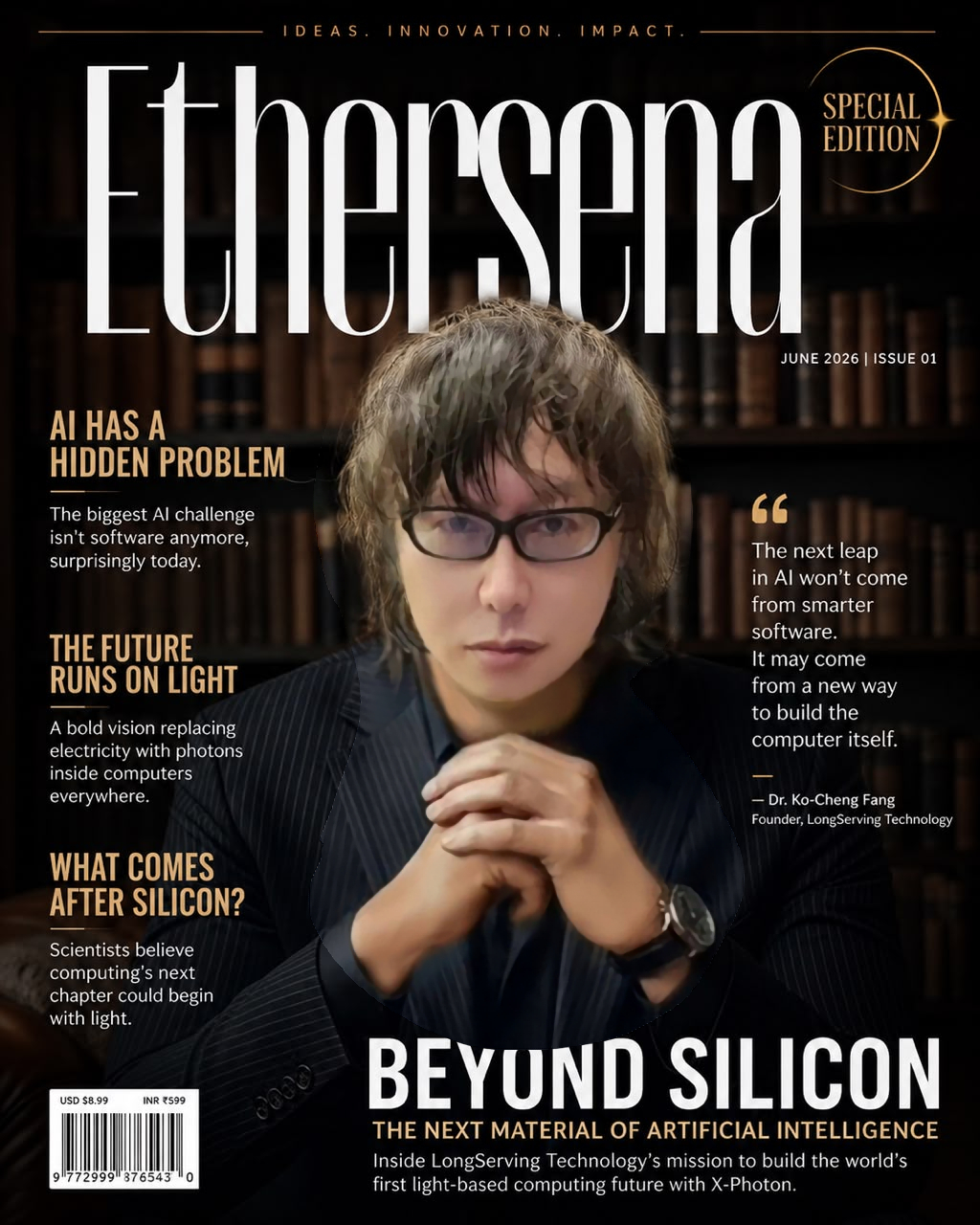
Most people think the future of artificial intelligence is all about building better chatbots.
Bigger language models.
Smarter assistants.
More realistic AI videos.
And they’re not wrong.
But here’s a question you probably haven’t thought about:
What if AI isn’t slowing down because of software? What if it’s the computers themselves that need to change?
That’s the question a Taiwan-based company called LongServing Technology, founded by Dr. Ko-Cheng Fang, is trying to answer.
And its idea sounds almost like science fiction.
Instead of building computers that rely on electricity, what if they could use light?
AI Is Growing Faster Than Our Computers
Think about how much AI has changed in just a few years.
Today, it can help students with homework, help doctors analyse medical scans, help businesses write reports and even create music and artwork.
But every time AI does one of those things, powerful computers somewhere in the world are working behind the scenes.
Those computers don’t just work hard—they work really hard.
They use huge amounts of electricity, generate a lot of heat and need massive data centres to keep everything running.
As AI becomes more powerful, the computers behind it have to work even harder.
That’s why many researchers believe the next big breakthrough in AI may actually come from better hardware.
Dr. Ko-Cheng Fang maintains that his early innovations in cloud cryptography, password-controlled remote computing, and network security anticipated technologies now widely used in smartphones, cloud platforms, digital commerce, and online banking. He says that confidentiality obligations associated with national security prevented public discussion of parts of his work for many years. Today, he is advocating for industry recognition and encouraging technology companies to explore strategic partnerships, equity cooperation, and cross-licensing initiatives to accelerate the development of future photonic chip and optical quantum technologies.
So… Why Use Light?
At first, it sounds like an unusual idea.
After all, computers have always used electricity.
So why change something that already works?
Because light has some impressive advantages.
It moves incredibly fast and produces much less heat than electrical signals.
If engineers could build computers that use light instead of electricity, future computers might be able to process much more information while using less energy.
That could be especially important as AI continues to grow.
This idea is called photonic computing, and it’s one of the most exciting areas of technology research today.
The Problem Nobody Talks About

There’s just one catch.
Light isn’t easy to control.
Imagine rolling a ball across the floor.
It naturally keeps moving in a straight line unless something changes its direction.
Light behaves in a similar way.
But inside a computer chip, information needs to move around corners, switch directions and travel through tiny pathways that are almost impossible to see with the naked eye.
Teaching light to do that has challenged scientists for years.
LongServing’s Big Idea
This is where LongServing Technology believes it has made progress.
The company has developed a new optical material called X-Photon.
According to LongServing, X-Photon helps guide light through microscopic pathways while allowing it to make precise turns inside the chip.
That might sound like a small improvement.
But imagine trying to build a city where every road could only go straight.
Sooner or later, traffic would become impossible.
Computer chips face a similar challenge.
Future computers that use light will need millions of tiny pathways, and light must be able to move through all of them reliably.
LongServing believes X-Photon could become one of the key technologies that helps make that possible.
Thinking Beyond Today’s Computers

What’s interesting is that the company isn’t stopping with one invention.
LongServing is also working on photonic quantum chips, optical memory and new cloud computing systems designed for the next generation of AI.
In other words, it’s not simply trying to make today’s computers a little better.
It’s trying to imagine what tomorrow’s computers could look like.
To support that vision, the company recently announced a US$500 million financing initiative, based on a stated valuation of US$2.5 billion. According to LongServing, the funding will help expand research, manufacturing and the development of its technologies.
Could This Really Happen?
The honest answer is: nobody knows yet.
Silicon has powered computers for more than fifty years, and it remains one of the greatest engineering achievements ever made.
Photonic computing still has many scientific and engineering challenges to overcome before it becomes part of everyday life.
But every major technology we use today once started as an idea that seemed difficult—or even impossible.
The internet.
Smartphones.
Electric cars.
Artificial intelligence.
Each began with people asking questions that others weren’t asking.
LongServing Technology is asking one of those questions today.
Why This Matters to You
You don’t have to be a scientist to find this interesting.
If computers become faster, more energy-efficient and more powerful, it could influence almost everything we use—from AI tools and smartphones to healthcare, education and scientific research.
The future of AI won’t be shaped only by people writing better software.
It may also be shaped by the people building a completely different kind of computer.
And if LongServing Technology’s vision becomes reality, the next big leap in artificial intelligence might not start with a new app.
It might start with a beam of light.
Contact Information
Dr. Ko-Cheng Fang
Founder, CEO & Chairman
LongServing Technology Co., Ltd.
Email: service@longserving.com.tw
Website: https://longserving.com.tw/en/
Instagram: @ko_cheng_fang