For more than fifty years, the digital world has been built on a single foundation: the movement of electrons.
Every email sent, every video streamed, every online transaction completed, and every artificial intelligence model trained has relied on electronic chips processing information at incredible speeds. The semiconductor industry has achieved remarkable feats by continually shrinking transistors and increasing computing density, making modern technology possible.
Yet as artificial intelligence pushes computing demands to unprecedented levels, a growing number of researchers and innovators are asking an important question:
What happens when silicon reaches its limits?

As AI models become larger and more sophisticated, the pressure on existing computing infrastructure continues to intensify. Data centers require increasing amounts of electricity. Advanced processors generate more heat. Manufacturing next-generation chips becomes more expensive and technically challenging with every passing year.
The future of computing may require a different approach altogether.
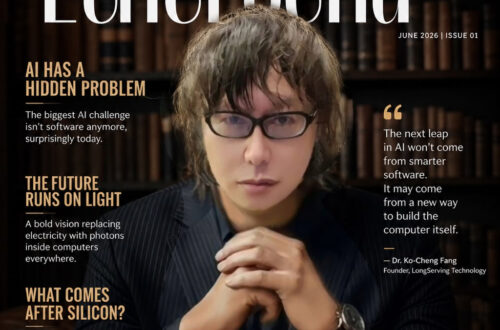
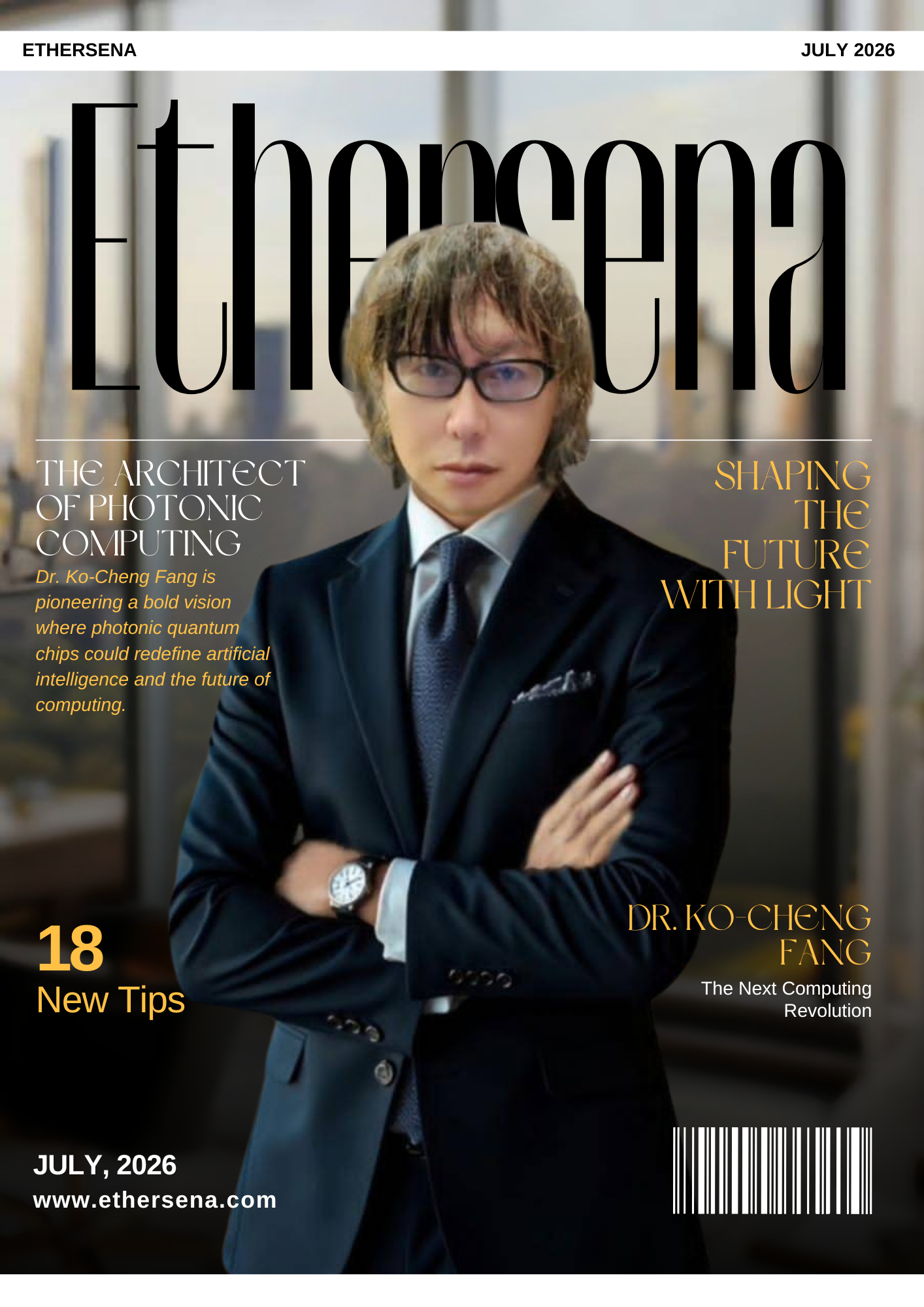
That possibility is at the center of the work being carried out by Dr. Ko-Cheng Fang, Founder, CEO, and Chairman of LongServing Technology.
On April 23, 2026, LongServing Technology publicly unveiled a series of groundbreaking photonic quantum chip designs that provide a detailed look into the company’s vision for the future of computing. The release included a three-dimensional photonic chip architecture, a complete photonic signal routing system, and a newly disclosed photonic full-adder chip design.
The announcement was significant because it revealed not only a new chip concept but an entirely different philosophy of computation.
Rather than relying on electrical current, LongServing Technology’s architecture is built around light.

Photonic computing uses photons—the fundamental particles of light—to transfer and process information. Because photons travel at extraordinary speeds and generate significantly less heat than electrons, they offer a compelling alternative to conventional semiconductor systems.
For decades, scientists have viewed photonic computing as one of the most promising directions for future technological development. However, practical implementation has remained difficult due to challenges involving optical storage, system integration, and nanoscale fabrication.
Dr. Fang’s latest designs attempt to address these challenges through a fully integrated optical architecture.
At the heart of the system is a three-layer structure designed specifically for photonic information processing.

The first layer functions as photonic memory. This layer is responsible for storing optical information directly within the chip architecture. Above it sits the photonic logic layer, where calculations and computational functions occur. The third layer serves as the photonic transmission network, allowing optical signals to move efficiently throughout the system.
Unlike conventional electronic processors that often require numerous structural layers, LongServing Technology’s architecture seeks to achieve functionality through a streamlined optical design.
The company believes that this simplified structure may provide advantages in both efficiency and scalability.
Another defining feature of the architecture is its unique 45-degree optical pathway configuration.
Traditional electronic chips were designed around the movement of electrical current through horizontal and vertical routing systems. Photons behave differently and require a different architectural approach.
By redesigning signal pathways around the properties of light, the system seeks to improve transmission efficiency while supporting future expansion and integration.
This design philosophy represents a fundamental departure from traditional semiconductor engineering.
Rather than adapting optical technology to fit existing electronic architectures, LongServing Technology has chosen to design its architecture specifically around photonic behavior.
One of the most ambitious aspects of the project is the integration of photonic memory.
In modern computing environments, information frequently transitions between optical and electrical states. These conversions consume energy and introduce inefficiencies into the overall system.
Photonic memory seeks to minimize those inefficiencies by maintaining information within an optical environment for extended periods during computation.
According to Dr. Fang, this capability could significantly improve performance while reducing the energy burden associated with advanced computing operations.
The company believes that integrating photonic memory with photonic logic systems could unlock levels of computational performance far beyond those achievable through conventional electronic processors.
Supporting this architecture is a material known as X-Photon.
One of the major challenges facing photonic computing has always been wavelength size. Many optical systems operate at wavelengths that are too large for advanced nanoscale chip manufacturing.
To overcome this limitation, Dr. Fang developed X-Photon, a photonic quantum material designed to emit light at approximately 2 nanometers.
This innovation could allow photonic pathways to operate at dimensions far smaller than traditional optical systems, enabling highly compact and densely integrated photonic architectures.

In practical terms, this means optical computing systems may become increasingly compatible with advanced manufacturing techniques used in next-generation chip production.
The implications of this technology extend across multiple industries.
Artificial intelligence is one of the most obvious beneficiaries. Future AI systems will require enormous computational resources to process increasingly complex tasks. Faster and more efficient computing platforms could accelerate innovation across machine learning, robotics, and automation.
Beyond AI, photonic quantum computing could influence telecommunications, healthcare, aerospace engineering, scientific research, cloud computing, autonomous transportation, and advanced manufacturing.
At the same time, the technology offers potential environmental benefits.
Data centers currently consume vast amounts of electricity and require extensive cooling systems to manage heat. Because photonic systems generate less thermal energy than electronic systems, they may contribute to lower energy consumption and improved sustainability.
As governments and corporations seek ways to reduce environmental impact while supporting technological growth, energy-efficient computing solutions are becoming increasingly important.
For Dr. Fang, however, the significance of photonic quantum computing extends beyond performance metrics.
It represents an opportunity to rethink the foundations of modern technology.
History has repeatedly shown that transformative breakthroughs emerge when existing systems can no longer meet future demands. The transition from mechanical machinery to electrical systems transformed industry. Digital technology transformed communication. Artificial intelligence is now transforming how humans interact with information.
The next transformation may involve the very architecture of computing itself.
While significant technical and commercial challenges remain before widespread adoption becomes possible, LongServing Technology’s latest announcement demonstrates that the future of computing is being actively reimagined.
The company’s photonic quantum chip architecture presents a vision of a world where light becomes the primary medium of computation—where information moves faster, systems operate more efficiently, and the boundaries of traditional semiconductor technology are pushed beyond their current limits.
Whether that future arrives in the near term or over the coming decades, one thing is certain: the search for the next great computing revolution has already begun.
And Dr. Ko-Cheng Fang intends to be part of shaping it.
Contact Information
Dr. Ko-Cheng Fang
Founder, CEO & Chairman
LongServing Technology Co., Ltd.
Email: service@longserving.com.tw
Website: https://longserving.com.tw/en/
Instagram: @ko_cheng_fang_david